When you carry a cup of water, steadying your hand does not necessarily stop the water from sloshing. Large storage tanks behave similarly during earthquakes: base isolation can reduce tank forces while making liquid-surface motion more prominent. This study adds a vibration-control device containing an inerter to an isolated tank.
The tank and liquid surface have different rhythms
Liquid response can be separated into components: some liquid moves more closely with the tank, while another part produces slower surface sloshing. Lead-rubber bearings beneath the tank change the system's dynamic properties. Alongside reductions in some force measures, they redistribute liquid motion.
The paper connects the inerter-based device in parallel with the isolation bearings. An inerter produces force related to the relative acceleration of its two terminals. Combined with a viscous energy-dissipation element, it forms a tunable dynamic-control system. Lumped masses, springs and dashpots represent the relationships among tank, liquid and base devices.
Sloshing is usually slower than local tank vibration, so different mass-and-spring branches represent different motion components. Changing the overall rhythm through isolation also changes relative motion between the liquid surface and tank. An inerter responds to relative terminal acceleration and can supply an inertial effect beyond that suggested by its physical size and mass. Coupled with a dissipative element, it adjusts relationships within the system rather than simply adding another piece of damping material below the tank.
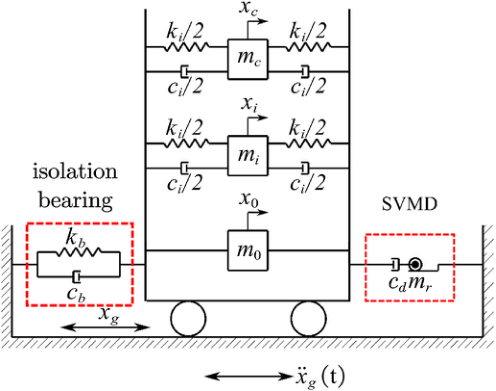
Reduce wave height while checking the tank wall
The study compares fixed-base tanks, isolated tanks, and tanks with both isolation and inerter-based mitigation. Measures include sloshing height, base shear, overturning action and hydrodynamic pressure. The examples show that a suitably configured device can improve both surface sloshing and base response.
Parameter changes reveal design trade-offs. Increasing inertance can reduce sloshing but may increase some base-force measures; additional damping helps control several response types. Hydrodynamic pressure profiles show how liquid motion becomes loading on the tank wall.
Read a pressure profile by first identifying which heights carry larger pressures, then comparing systems. Sloshing height describes movement at the top; base shear describes overall horizontal force transferred to the foundation; pressure profiles distribute liquid demand over the wall. Together they reveal whether a device improves overall motion, local forces or both, and help identify benefits and accompanying changes caused by parameter adjustment.
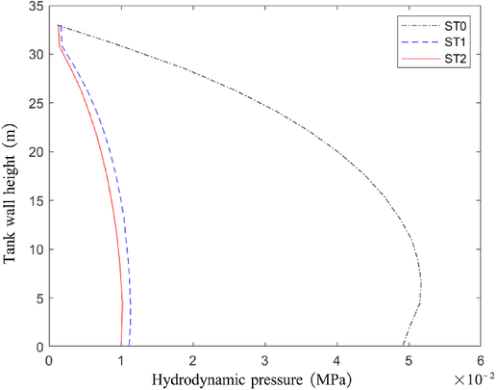
Tune a coordinated set of parameters
Soil conditions and liquid height also affect device performance. Mitigation efficiency changes on softer sites or at higher liquid levels. Tank operating conditions must therefore be considered alongside the site and device.
The study moves the objective from reducing tank forces to controlling tank and liquid together. Considering wave height, pressure and base actions simultaneously before choosing inertance and damping helps the different parts respond more coherently to earthquakes.
Changing liquid level alters both participating mass and sloshing characteristics, which is why parameter design must account for operating conditions. The same device settings may behave differently at different fill levels, and the frequency content of site motions further affects their coordination. Parameter comparisons provide a fuller design map: first specify which demands need control, then check performance as site conditions and liquid level vary.