A piece of rubber must support a building while also deforming sideways in an earthquake—apparently conflicting requirements. Conventional laminated rubber bearings insert reinforcing layers between rubber sheets to carry vertical load while permitting horizontal deformation. This study replaces the steel reinforcing plates with fibre-reinforced composite material.
Inside a bearing, each layer has a job
Rubber compressed on its own readily bulges sideways. Reinforcing layers restrain that bulging and increase vertical load capacity. Under earthquake-induced horizontal movement, the rubber layers deform in shear to provide isolation.
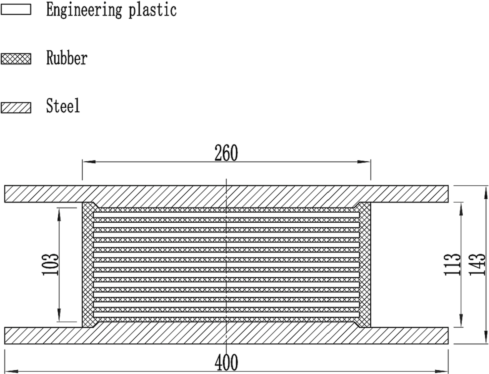
The paper makes FRP reinforcing layers from alkali-free fibre fabric and vinyl resin, considering details such as end plates and interface bonding. This material combination offers another option for reducing device weight and developing isolation for low-rise buildings. The layered cross-section shows how the materials work together inside the device.
The contrast between vertical stiffness and horizontal flexibility comes from the layering. Under compression, reinforcement limits outward rubber bulging. Under lateral force, thin rubber sheets shear one by one, and their deformations add up to the bearing's overall displacement. FRP layers provide restraint and transfer forces; their stiffness, thickness and bond quality all affect whether the bearing performs as intended. The new material must be understood within this division of labour.
First compress it, then push it sideways
Compression, shear and ultimate-deformation tests examine load capacity, stiffness and deformability, while finite-element models reveal internal stresses. Changing vertical pressure also changes horizontal mechanical behaviour, so vertical and lateral performance must be examined together.
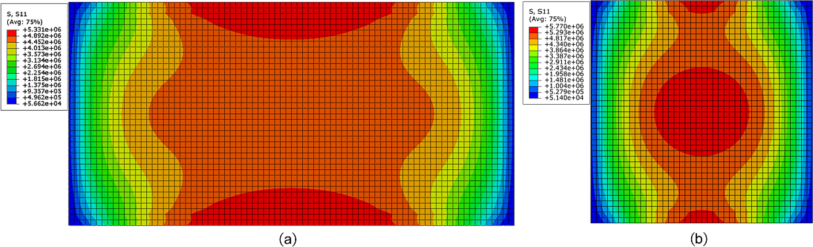
Stress contours reveal regions that are difficult to observe directly. Colour changes show stress distribution, with local peaks indicating greater demands on materials and interfaces. Plan dimensions and the relative thicknesses of rubber and FRP affect these local actions.
Experiments and simulations reveal different levels of behaviour. Tests directly relate overall force to displacement as the device is pushed and pulled back. Numerical models show where internal stresses are high and how they redistribute when geometry changes. The study also examines pressure and loading conditions because building weight remains on the bearing throughout the horizontal earthquake motion.
Design the new material together with its details
The study concerns more than replacing one material. It examines how the modified device transfers load and deforms, and how geometry affects performance. Lighter reinforcement offers possibilities for transport, installation and lower-cost applications; testing and analysis express those possibilities as comparable performance measures.
Between a sheet of fibre fabric and a working isolation bearing lie material properties, interfaces and the overall detail. These relationships must be understood together for the new material to become a functional seismic-protection device.
Lower weight and simpler construction are attractive for low-rise buildings, but selection still needs clear performance data: allowable horizontal deformation under design vertical load, behaviour after repeated movement, and changes in stiffness with size. The paper connects material detailing, loading tests and internal-stress analysis so these questions can be addressed individually, supporting further optimization of FRP and rubber thicknesses.