How an arch bridge spanning a valley vibrates depends on the bridge itself and on the motions arriving from both banks. Real seismic waves leave a fault and travel through three-dimensional geology and terrain. If we simplify them into a particular incident wave type, which details of the bridge’s force distribution change?
From a complete source scenario to simplified wave inputs
The paper examines an arch bridge in a V-shaped valley, comparing a full three-dimensional ground-motion simulation based on a reverse-fault source with Rayleigh-wave and P–SV-wave inputs. The three inputs retain different physical information, producing different directional combinations and spatial variations at the bridge supports.
The study connects the site model to dynamic bridge analysis, tracing the process from wave propagation to structural forces. The original two- and three-dimensional scenarios illustrate that a terrain cross-section on paper captures only part of the real spatial relationship.
A two-dimensional site section highlights propagation mechanisms in one plane. A three-dimensional model allows diffraction and scattering in more directions and retains the spatial relationship between the source and valley. For the bridge, this information ultimately appears as motion in three directions at each support. By applying different inputs to the same type of bridge analysis, the study examines how retaining or simplifying that information changes displacement and internal forces, translating wave-field complexity into comparable structural-response differences.
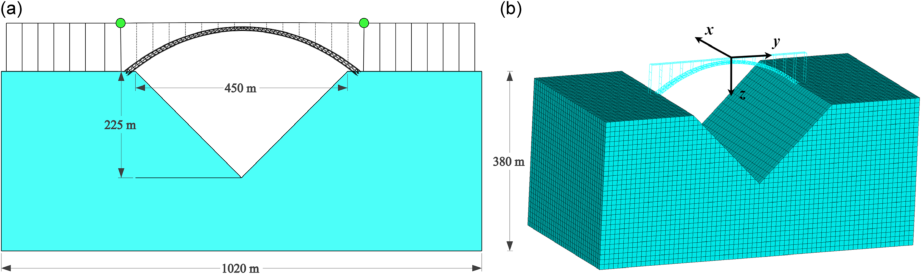
The same bridge, different combinations of motion
The full three-dimensional input excites a richer set of motions, including rotational modes in different directions. Rayleigh and P–SV waves each emphasize vibrations in particular directions. Much as plucking an instrument at different points and in different directions excites different combinations of sound, the bridge exhibits different combinations of participating modes.
These differences also change internal-force distributions. In the study, high axial forces under the full three-dimensional and Rayleigh-wave inputs occur at locations including the arch crown and springings, whereas the P–SV case concentrates them more at the springings. The original force curves show that both the magnitude and location of the peaks change.
Rotational modes help explain this pattern. Differences in horizontal or vertical motion between two supports can produce overall rotation in different directions, superimposed on local bending. Full three-dimensional input retains more directional combinations and can therefore excite several motion patterns together. Their superposition over time changes tension, compression and bending demands at the crown and springings. The plotted force distributions are the member-level outcome of this process: a shift in peak location deserves as much attention as a change in peak magnitude.
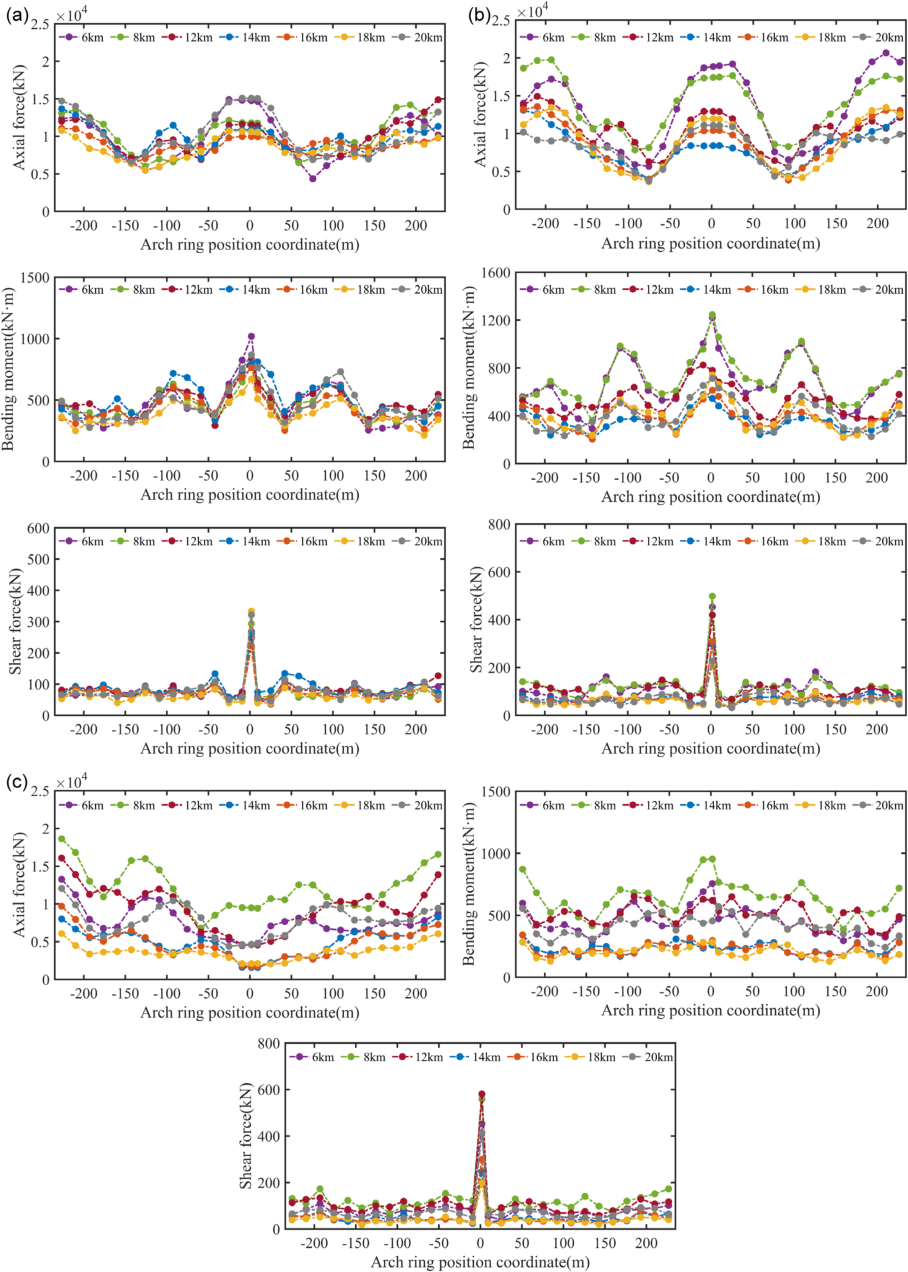
Choosing an input means choosing which mechanisms to retain
Simplified wave fields help isolate particular mechanisms, while full three-dimensional source simulations retain more directional and propagation characteristics. Different simplifications may overestimate or underestimate different force measures. Comparisons can therefore be targeted to critical members and dominant vibration patterns.
The study links three-dimensional waves in the site to multidirectional bridge motion. For valley-spanning structures, understanding how waves arrive and how the bridge responds helps identify seismic-analysis approaches with a clearer physical basis.
This also explains why input simplifications should be evaluated using several force measures separately. A simplification may closely reproduce the full three-dimensional axial force yet behave differently for bending moments or at another location. Engineers can start from the performance demands of critical members, identify the wave-field features that need to be retained, and check the trade-offs through focused comparisons. Applied to a valley-spanning arch bridge, the study provides concrete mechanical clues for selecting seismic inputs at complex sites.