Old tyres can be ground into particles and mixed with sand to create a new fill material. Sand provides support through particle contacts, while rubber introduces a more compliant deformation response. When this mixture is used in a road subgrade, how do earthquake-induced displacement, stress and local deformation change?
Changing the character of the material inside a subgrade
The paper develops a rubber–sand subgrade model and compares different rubber contents under rare-earthquake input. A subgrade includes slopes, interior regions and a base, so even one mixture proportion encounters different loading conditions at different locations.
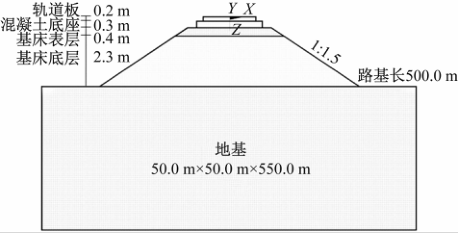
Adding rubber particles changes the mixture’s stiffness and deformation characteristics. The study therefore examines relative displacement, acceleration, equivalent stress and equivalent strain together, rather than judging performance by a single peak. The cross-section shows the relationship between the shoulder, slope and interior fill, helping explain why the results vary spatially.
Subgrade response needs to be examined by location. The slope lies close to a free surface, while interior fill is more constrained by surrounding material; even at the same elevation, the two regions can experience different forces and deformation. Rubber–sand mixtures influence wave propagation and local deformation through their overall material properties. By comparing rubber contents and sampling locations across the section, the paper breaks the question “What changes when we change the material?” into “Which regions change most, and in which response measure?”
Some measures change markedly; others mainly follow the waveform
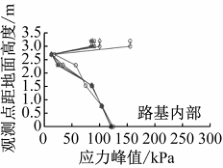
The calculations show clear effects of rubber content on relative displacement and the distributions of equivalent stress and strain. Conventional fill produces larger displacement and stress, with differences between slope and interior locations at the same elevation. The shoulder and slope toe merit particular attention.
Adding rubber eases some concentrated deformation. In the paper, the 5% and 10% rubber-content cases have more uniform strain distributions. Acceleration amplification, meanwhile, is influenced more by the input earthquake waveform, with relatively limited differences between rubber contents. Material changes thus affect different responses through different pathways.
Acceleration, relative displacement and strain also describe different things. Acceleration measures how quickly motion changes; relative displacement measures how far two locations move apart; strain describes how much a small local piece of material is stretched, compressed or sheared. Rapid shaking at a point does not necessarily imply equally pronounced local deformation. Comparing these measures side by side reveals that rubber content primarily changes deformation and stress distributions, while acceleration amplification continues to follow the input waveform more closely.
From reusing tyres to choosing a suitable subgrade mixture
Recycling materials opens new possibilities, but engineering design must still determine the appropriate proportion, where to use it and which performance measure to improve first. Lower stress, more uniform deformation and displacement control need to be weighed against the road’s functional requirements.
The study connects the material characteristics of rubber particles to the spatial distribution of seismic subgrade response. Comparing several measures and critical locations makes it possible to identify more specifically how the mixture changes subgrade behaviour, informing further work on mixture proportions and construction details.
A more uniform distribution matters in subgrades. If a similar total deformation concentrates within a small region, the local material must accommodate greater strain. If deformation spreads over a larger region, local peaks may be reduced. Evaluating a mixture therefore involves not only the reduction in its maximum response, but also the location and extent of high-response zones along the slope and within the fill. This spatial comparison helps connect mixture design to material choices and details at critical locations such as the shoulder and toe.