Near a fault, the ground can shake back and forth and also end up in a different position after the earthquake. For long tunnels, bridges and regional infrastructure, researchers want to know what rapid vibration and fault slip each contribute, and how those contributions are distributed in space.
Using the same yardstick across a region
A ground-motion record can be decomposed using its frequency characteristics. Regional engineering problems, however, often involve inputs at many locations. If each location uses its own chosen dividing frequency, the spatial relationships between the processed motions can become difficult to compare.
The paper proposes a regionally consistent decomposition method. It combines information from several locations and motion components to select one cutoff frequency, then separates the original motion into dynamic and fault-slip-induced components. For the regional case studied, the optimized cutoff frequency is 0.29 Hz. That setting provides consistent processing for this particular dataset.
A unified cutoff does not make the decomposed waveforms identical at every location; it applies the same rules for distinguishing motion components. Spatial differences in the original records remain, allowing comparisons near and far from the fault, at different depths and in different directions. This consistency matters for long structures subjected to simultaneous motion at several supports: the structure receives a related set of inputs, and processing needs to preserve their comparability.
Acceleration and displacement tell different parts of the story
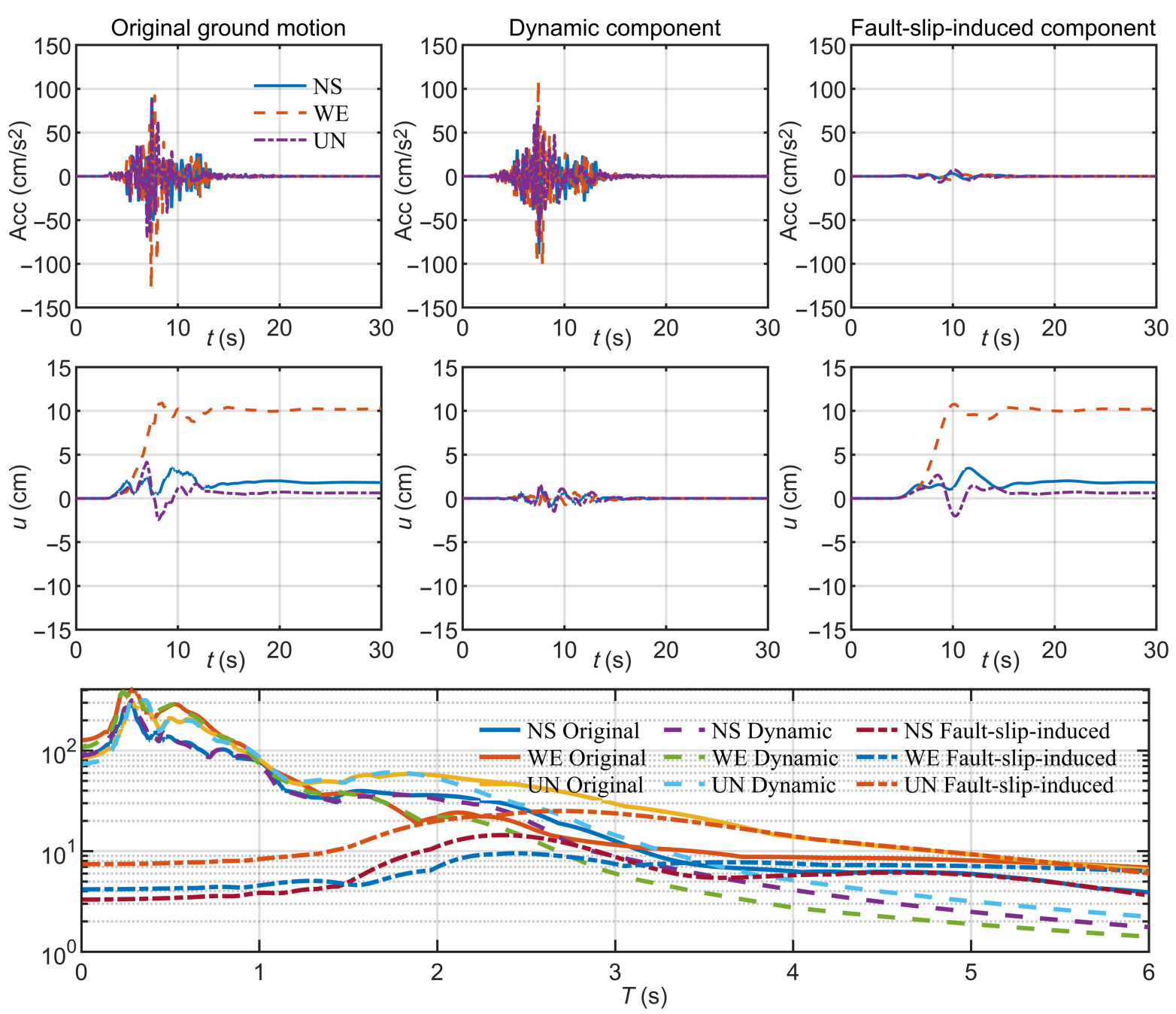
The original figure places the complete record beside the two components. In the upper acceleration plots, the dynamic component retains the main rapid fluctuations. In the lower displacement plots, the slip-induced component shows more pronounced long-term changes and residual displacement. Together, they represent different constituents of the original motion.
The response spectra add another perspective. Short-period response reflects the dynamic component more strongly, while the contribution of the slip-induced component becomes more prominent at longer periods. Fault-parallel and fault-normal directions also differ, so the decomposition needs to be interpreted in terms of both direction and period.
One readily visible feature in a displacement plot is whether the curve returns to its starting point after the earthquake. A lasting offset corresponds to residual displacement, while oscillations that gradually settle more strongly reflect dynamic motion. A response spectrum asks a different question: how would a collection of structures with different vibration periods respond to these components? Reading time histories and spectra together shows how the same decomposition affects both the interpretation of ground motion and the assessment of structural demand.
From one curve to an entire region
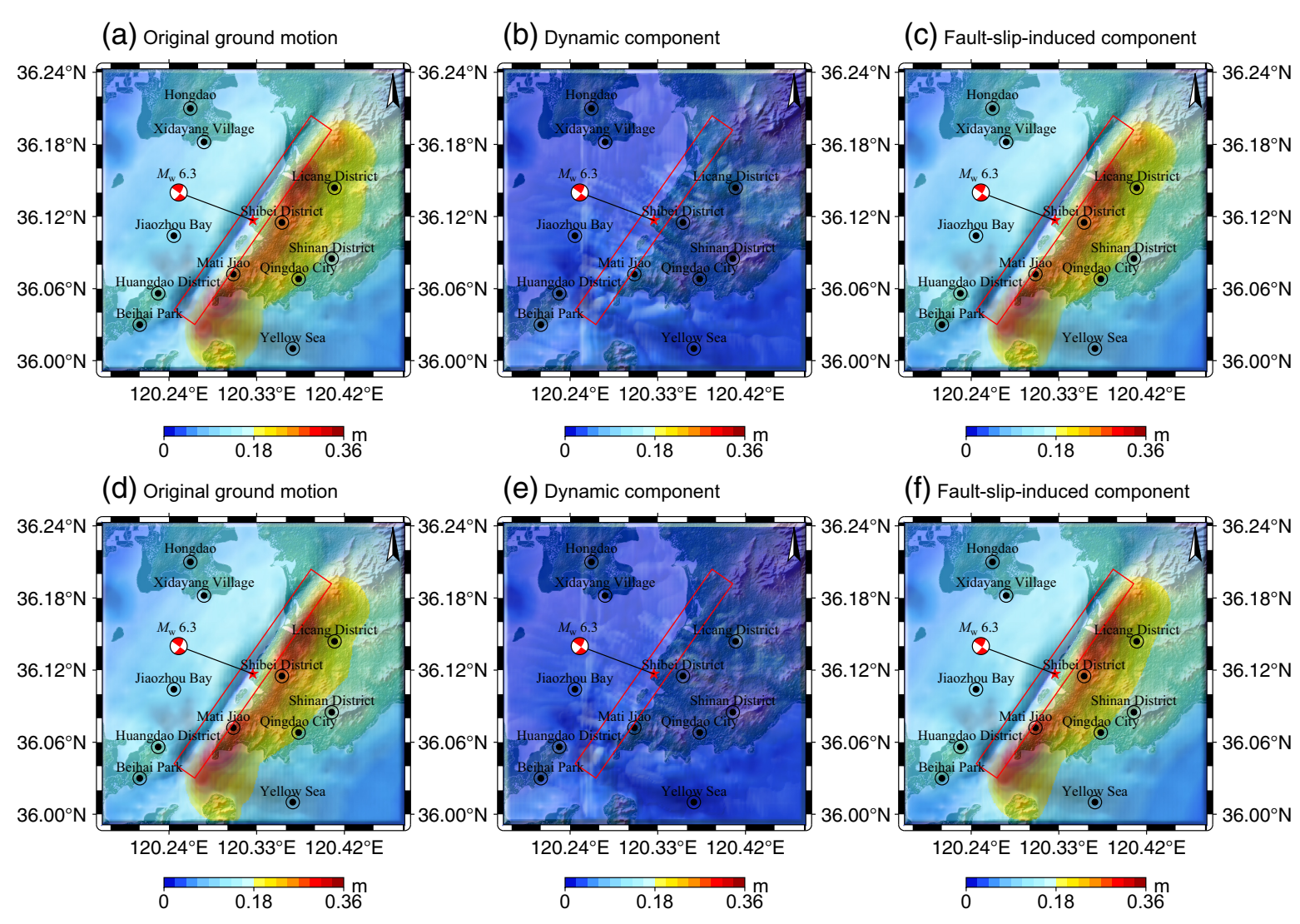
The regional maps show that the peak-displacement pattern of the original motion is closely related to the spatial characteristics of the slip-induced component, while the dynamic component plays a more important role in measures such as acceleration. Comparisons between the surface and different underground depths reveal how this division varies in space.
The method provides mutually consistent input components for regional structural analysis. Researchers can preserve spatial relationships while comparing how vibration and slip affect engineering structures, making the distinct mechanisms within complex near-fault ground motion easier to identify.
The regional maps also show why a peak measure must be interpreted in its spatial context. High-value bands near the fault, surface–depth differences, and variations parallel and normal to the fault can create different relative motions along a long structure. Displaying the original motion and both components side by side helps identify which component more closely follows a particular spatial pattern. Applying them to the same structural model then provides a clear starting point for tracing the deformation caused by vibration and slip separately.