A long bridge may cross several geological layers. When seismic waves arrive, its piers may begin shaking at different times and with different amplitudes. Imagine several people carrying a long pole: if their steps do not match, the pole experiences additional pulling and bending.
Give the model the motion of every pier
Engineers call this multi-support seismic excitation. The model must know how each support moves before calculating the response of the whole bridge. Engineers may prescribe displacements directly, convert ground motion into equivalent forces, or attach very large additional masses at the supports and use inertia forces to drive their motion.
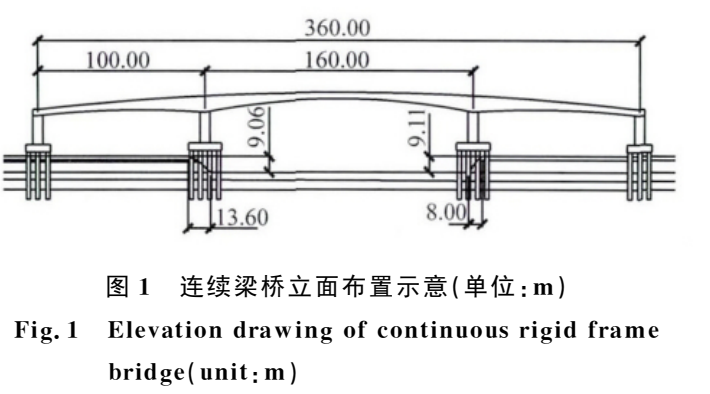
For a continuous rigid-frame bridge, the paper compares direct solution, displacement input, relative-motion and large-mass methods. With the same bridge and the same ground motions, can a different way of applying those motions produce a different answer?
Multi-support excitation can be understood through two scenarios. In one, the same wave reaches successive piers, like people stepping forward one after another. In the other, different local sites also change the amplitude and waveform at each pier. The first emphasizes travel-time differences; the second contains richer spatial variation. Comparing both scenarios on the same bridge reveals which differences each numerical method is sensitive to and helps distinguish algorithmic effects from site effects.
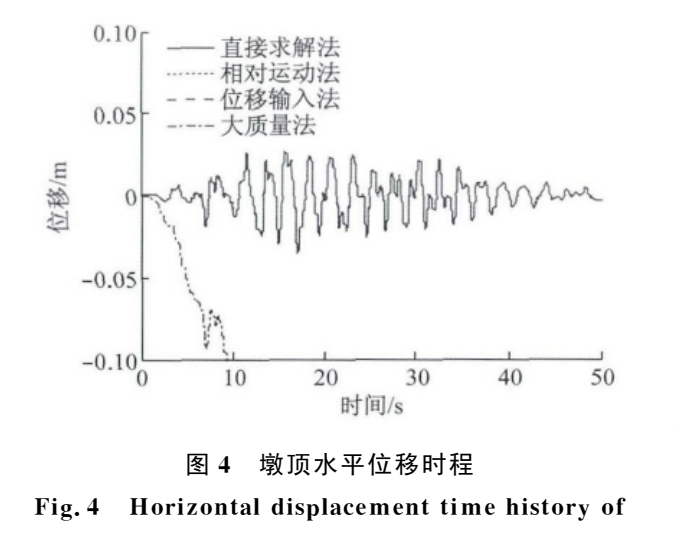
Why can displacement drift when acceleration looks right?
In the example, the first three methods agree well. The large-mass method reveals an important issue: acceleration can appear reasonable even when displacement and internal forces deviate substantially.
The explanation lies in converting acceleration into displacement. Velocity accumulates acceleration over time, and displacement accumulates velocity. A small baseline error can become persistent displacement drift after two integrations. If supports drift differently, the model imposes extra deformation on the bridge and changes its internal forces. Curves that wander to one side make this problem visible.
Drift changes internal forces because the bridge connects multiple supports. If every pier slowly translates together, relatively little additional distortion occurs. If one drifts left while another drifts right, the deck and piers must accommodate incompatible motions. The model treats this artificially introduced relative displacement as real structural deformation. Input checks should therefore examine not only whether peaks look correct, but also whether the curves finish at reasonable positions after the earthquake.
Use a mutually consistent set of motions
Ground acceleration, velocity and displacement describe three aspects of the same motion. Preparing multi-support inputs requires consistency between their time histories and checks for drift introduced by processing.
The study turns an easily overlooked numerical detail into a clear engineering issue: when piers move independently, relative support displacements directly affect bridge forces. Choosing the input method and checking displacement histories are as important as building the bridge model itself.
The comparisons suggest a practical checking sequence: first compare the motions actually produced at the supports, then inspect bridge displacements, and finally examine shear forces, bending moments and axial forces. This traces where differences enter the model instead of waiting for an unusual force peak and guessing its cause. Quality control becomes a checkable chain: are the ground motions consistent, does the algorithm transmit them correctly, and does the structure respond reasonably to their relative movement?