Hard rock seems reassuringly solid. If a cable-stayed bridge stands on rock, can its supports simply be treated as fixed? This paper separates two questions that are often confused: whether the bridge causes the rock to move, and whether seismic waves arriving at different supports are the same.
One bridge, three numerical portraits
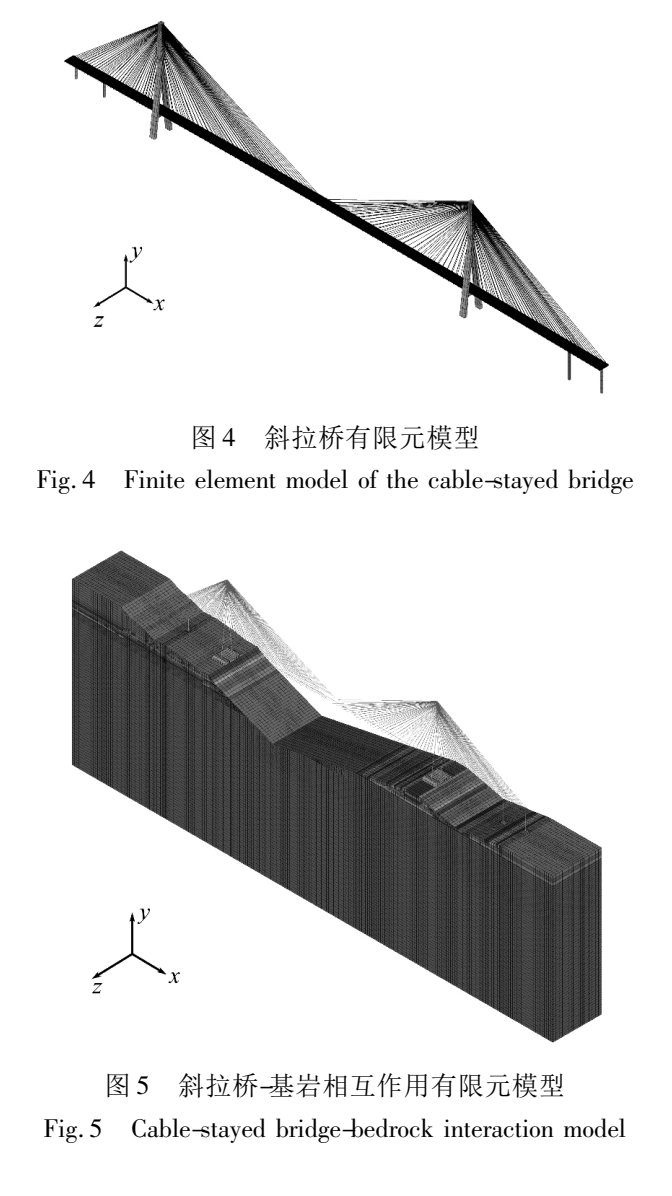
The simplest portrait places all supports on rigid ground and gives them identical earthquake motion. A more detailed version keeps the rigid-foundation assumption but supplies each support with the motion at its own location. The most complete model includes both the bridge and surrounding bedrock, allowing them to interact.
The paper compares these three models for a long-span cable-stayed bridge on bedrock. The full model contains a large rock mesh and requires substantially more computation. The comparison helps identify exactly what important information this extra complexity contributes.
Interaction here works in both directions: ground motion drives the bridge, and bridge inertia feeds forces back into the foundation. Site effects, in contrast, describe how terrain and geological layers alter waves before they reach the bridge. These occur at different stages. The rigid-foundation, multi-support model provides a useful middle step: comparing it with uniform excitation isolates site differences, while comparing it with the integrated bridge–bedrock model reveals the additional effect of foundation feedback.
Which difference really matters?
For the bridge and bedrock conditions studied, including bridge–rock interaction changes the response relatively little. Including local-site differences in the inputs, however, changes the results appreciably. When this spatial variation is neglected, the relative error in some peak structural responses reaches 48.66%.
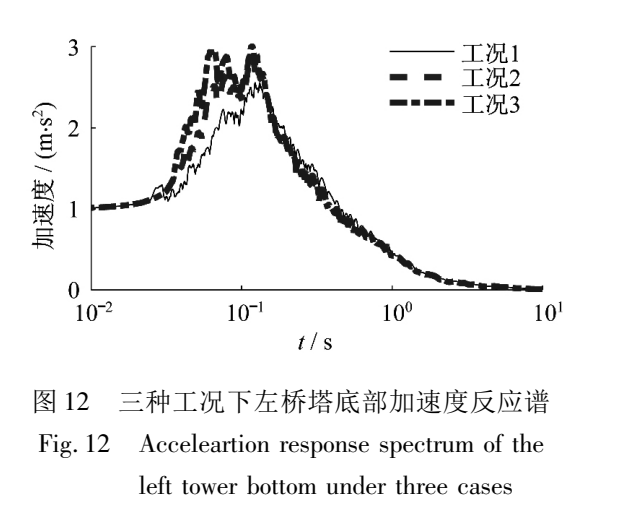
Return to the long-pole analogy: very stiff bases do not necessarily move identically. Waves travelling through different terrain reach the supports with different motions, and those differences are transmitted to the bridge. The response spectra compare the dynamic characteristics of these distinct inputs.
Case 1 uses uniform excitation, case 2 uses multi-support inputs accounting for local sites, and case 3 analyses the bridge and bedrock together. Each curve comparison therefore has a specific meaning. The spectra describe motion at a support location, whereas 48.66% refers to comparisons of peak structural response in the paper. Support input, bridge deformation and member forces form three successive stages, each answering a different question.
Spend computational effort where it matters
For the type of bedrock-supported cable-stayed bridge examined here, a multi-support model on a rigid foundation can retain the main response characteristics while reducing modelling effort. The essential step is to analyse the site first and provide appropriate inputs to the individual piers.
The value of this work is a physical basis for simplification. Engineers can focus more effort on the relationship between topography, wave propagation and support locations, allowing model complexity to follow the mechanisms that matter.
This comparison strategy also helps plan numerical work. Start with contrasts that separate key mechanisms, identify what foundation flexibility and spatially varying inputs each change, and then decide how detailed the final model needs to be. In this hard-bedrock setting, multi-support excitation captures important differences, while the extensive integrated rock model adds relatively small response changes. Letting physical mechanisms guide model selection aligns computational size and workload with the engineering question.