After an earthquake, some almost level sites retain substantial horizontal displacement. Without an obvious steep slope, why can soil accumulate movement in one direction? This study examines how two kinds of seismic waves work together, exploring a mechanism involving Rayleigh waves and shear waves.
Pushing while changing the grip
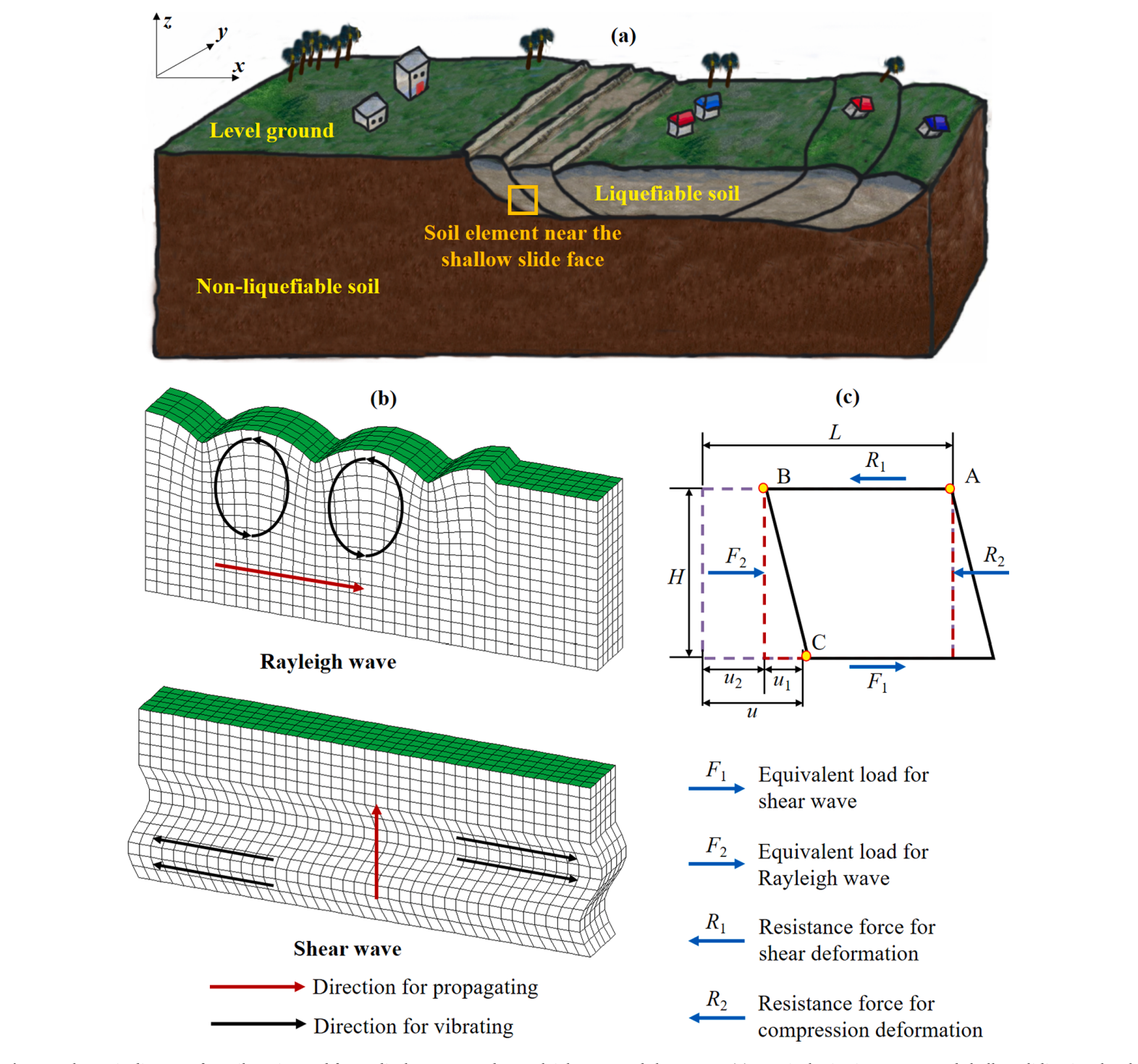
Shear waves apply alternating shear actions to soil, while Rayleigh waves produce coupled horizontal and vertical motion. Vertical motion changes the pressure acting on the soil and therefore its ability to resist shear deformation.
Imagine pushing an object against a tabletop: it is harder to move when pressed down firmly and easier when the downward pressure decreases. If the back-and-forth force and pressure changes follow a particular rhythm, movement in one direction can exceed the return movement. In soil, increasing pore-water pressure and decreasing strength during an earthquake make this asymmetry easier to accumulate.
The key is that motion in the two directions no longer cancels over a cycle. When soil is pushed one way under lower normal pressure and weaker shear resistance, it may deform more. During the reverse push, pressure and resistance recover, and the return movement may be smaller. Repeated cycles turn small imbalances into appreciable displacement. The paper first demonstrates this relationship in a simplified element, then examines whether it persists in the overall response of a layered site that can liquefy.
Combine the waves and displacement starts to accumulate
After explaining the forces with a simplified soil element, the study uses a soil model capable of representing liquefaction for site analysis. It applies shear waves, Rayleigh waves and their combination separately. The combined input produces more pronounced cumulative lateral displacement in the comparisons.
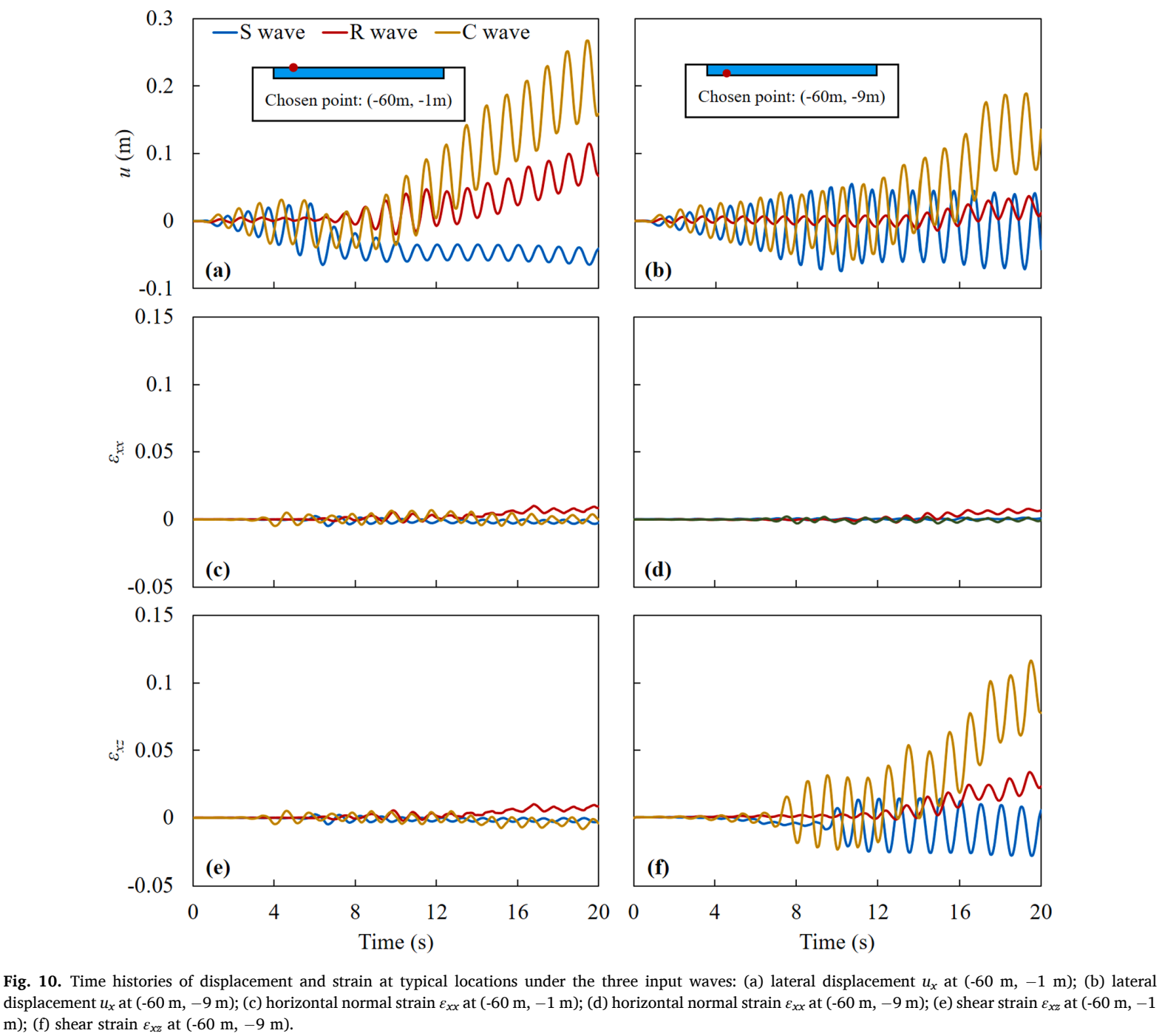
Blue, red and orange curves represent the three inputs. The upper displacement histories show the combined input progressively shifting the ground to one side. Strain curves below help reveal how deformation develops within the soil. The interface between liquefiable and non-liquefiable layers is an important deformation location in the study.
The two strain types provide different information. Horizontal normal strain describes stretching or compression along the ground, while shear strain describes relative distortion between layers. Results at two depths are shown side by side to connect surface movement with deeper shearing. When deformation concentrates near the interface between a liquefied layer and more stable soil beneath, the upper soil can move laterally along a relatively concentrated shear zone. This explains the internal deformation behind the overall surface displacement.
The timing between the motions matters
Wave amplitude, frequency and the phase relationship between the two waves all change accumulated deformation. Even when inputs contain both horizontal and vertical movement, a different sequence or rhythm can produce a different final soil displacement.
The study adds a physical explanation for large deformation in nearly level liquefiable ground: besides surface slope, wave coupling can drive directional accumulation. Preserving relationships between the components of seismic input helps explain where the soil ultimately moves.
Why does phase matter? It determines whether vertical motion is adding or relieving pressure when horizontal force becomes large. Frequency determines how many cycles the coordination between the motions can persist. By varying these conditions, the study observes different lateral displacements in the same type of soil. The time relationship between input components is itself important information. Retaining it in liquefaction analysis connects seismic-wave motion more clearly to permanent post-earthquake deformation.