An arch bridge connects two sides of a valley. During an earthquake, however, the valley changes wave propagation and surface movement. Will shear waves arriving from below and Rayleigh waves travelling near the surface make the same bridge move in similar ways?
First examine how the valley changes incoming waves
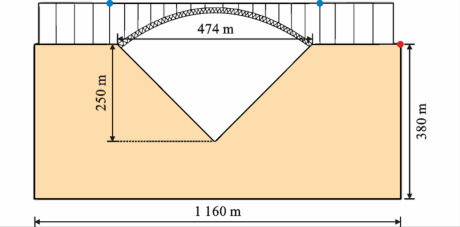
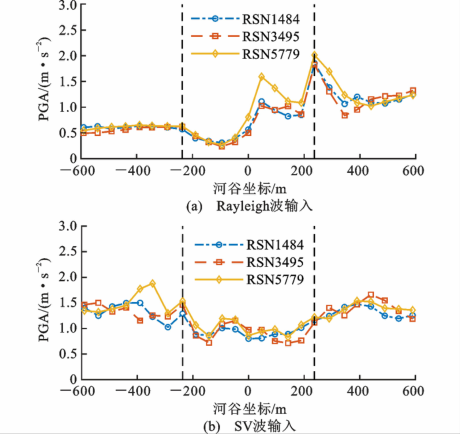
Rayleigh waves contain coupled horizontal and vertical motion, with trajectories different from those of a single shear wave. Passing through a V-shaped valley, they undergo reflection and scattering at the slopes, and the two banks experience different motion histories.
The paper builds a valley–arch bridge model and compares site and bridge response under Rayleigh and SV waves. Ground-motion changes differ on the incident and outgoing sides: under the conditions studied, motion is amplified on the incident side and reduced on the outgoing side. These differences reach the arch through its end supports.
The arch's load-transfer system connects the two bank inputs. Its curved shape carries loads toward the springings, and horizontal and vertical support motions jointly alter that path. Once the valley has changed the amplitudes, phases and directions of motion at the ends, the arch accommodates the differences through bending, axial deformation and overall rotation. The bank motions are therefore not merely independent curves, but a set of inputs that determines how one bridge deforms.
The bridge's vibration patterns change as well
The two wave types excite different bridge motions. In the study, Rayleigh waves more prominently excite rotation about the transverse axis, while SV waves show rotational characteristics in another direction. Higher modes also contribute. A mode is a natural pattern of movement; several such patterns combine to form the actual earthquake response.
For internal forces, the Rayleigh-wave case produces larger axial-force, bending-moment and shear-force demands. Some axial-force and bending-moment peak ratios exceed 1.8. Plotting axial force along the arch shows where the differences concentrate, rather than only giving one maximum.
Axial-force curves describe tension and compression along the arch, while bending moments more directly describe flexural demand. Compare the same force measure at the same position before looking at the shape of the whole curve. Peak ratios above 1.8 correspond to changes in combinations of motion directions and modal participation. Interpreting the number together with the vibration pattern explains why another wave input can impose greater forces on the same bridge.
Know the incoming waves as well as the bridge
Arch-bridge seismic behaviour depends jointly on structure, site and input. Across pronounced terrain, wave type, propagation direction and differential bank movement together change demands at critical locations.
The study highlights the close connection between site analysis and bridge analysis. Including the valley's modification of waves and tracing the vibration patterns it excites helps identify seismic demands on the arch and springings more specifically.
Modal analysis connects site results to member forces: first determine what support motions each wave generates, then identify which bridge movement patterns they excite, and finally locate high internal forces. This path helps designers target further analysis and detailing. Valley geometry and incoming-wave conditions must be considered with bridge form; the connection between site and structure is itself an important part of the seismic problem.